
Leading conversations that matter

Leaders have important conversations with others all the time, and how you handle them matters to you, to the other person, and to how progress gets made.

Sometimes we need to have "difficult conversations" or "tough conversations". Perhaps you've got a conversation like that coming up, or you are thinking of one that happened recently, and you'd like to learn from it. This post is for you!
I call them conversations that matter. Each conversation provides leaders with fresh opportunities to find out together what really matters to be working on. Yet they also give us a sense of difficulty or toughness at times, because of how we perceive the stakes involved, whether for ourselves, our conversation partner, or our organisation.
When you tune into that signal, it’s one of the clues that it matters how your interaction goes, so let’s pay attention to it. How do you have better conversations that matter? In today’s post:
What derails conversations that matter.
How to phase conversations to tackle behavioural change over time.
Tackling the current situation, behaviour, and impact, in a way that lands.
Identifying your conversation partners’s social needs, to keep them in the change work with you.
How to have the conversation, in practice.
Read on for a bonus tip towards the end of this practical piece to help you really embed this into your conversations at work. Let’s explore!
1. What derails conversations?
Can you remember a time when you fumbled a conversation that mattered? I can. Although it was years ago, it teaches me to this day about the importance of working consciously on my mindset and skillset for tricky conversations coming up.
Perhaps you can bring to mind a similar conversation, from your own leadership context.
In a small room, nearby my team’s work area, I was waiting for a member of my team (I’ll call him Greg) to arrive for a feedback conversation about a partnership he was working on. I felt nervous, and wondered how our chat would go.
What I needed to share was feedback from the stakeholders he was working with, about how he was communicating. Taking up all the time in meetings, talking over stakeholders, and strongly advocating preferred solutions at the expense of space for others’ ideas. Some partners had started to report frustration about how these conversations were going, and in a few cases had begun to seek workarounds - including coming directly to me to greenlight their ideas, rather than making decisions together with him.
Back to the conversation. Greg came in and sat down, crossing his arms and sitting back in his seat at the table, and he looked right at me as if to say “OK, let’s get into it”. I wondered how much he knew already about what we’d be discussing. I met his eyeline for a moment, then inspected the texture of the table for a while. I gathered myself, and looked up again, hoping to feel more ready to begin. I didn’t feel ready, but I began.
The situation we needed to talk about was clear, concrete, and practical. Yet I was holding so many swirling stories in that moment: what he was thinking, what he might say, and how he might react to the feedback I needed to give.
What got in the way of the conversation we needed to have was my own internal dialogue, which seduced me into listening to a bunch of stories about the risks I might encounter in our chat, rather than tuning into the moment. What would Greg think about the feedback? What if he dominated our conversation too? What if … what if… So much pressure to load on one conversation!
What happened next? As I spoke, I heard my nerves jangling tensely in my voice, which had become strangely high-pitched for some reason. My words came out in a rush, and as I noticed them rushing out, I spoke even faster. Inevitably, as I wobbled my way through the conversation, my hold of the subject matter got looser and I was way less clear than I should have been.
The result? I allowed the situation, the behaviour, and any associated impact, to continue a while longer than I intended. Later, we did have the conversation we needed to have, the right way - and from there, I was able to help Greg perceive and accept his role in the dynamic, and encourage him to use his powerful solutioning skills to tackle an important goal: building the confidence and capacity of partners to come up with initiatives that they could take ownership of, from idea to impact.
As a result of leading many conversations that matter - and as a coach of leaders who are working to better tackle such conversations - I have become curious about how leaders can better meet the moment of challenging conversations. Today I want to share with you two simple, and effective, tools that I have found help leaders to prepare for and hold the conversations that matter. But before we get into that, let’s talk about the phases that people need to work through, to navigate behaviour change.
2. Building conversations towards change
Leaders naturally want to make positive, beneficial changes in organisations, by leading others from a current situation to a better future situation in which the important work has been progressed with. In doing that, though, we don’t want the people we lead to feel “done to”. So, the goal is to cultivate the conditions that will help the person take ownership of their part of the change that’s needed.
Here’s what I use to anchor this kind of change work with individuals.
Three steps towards behaviour change:
1. Build their awareness of how they’re doing
2. Encourage them to accept where they're at on thinking, choices, and behaviours
3. Work with them to identify actions they can take on growth opportunities and improvement needs, now and ongoing.
Think about the implications of not cultivating these three As:
If they stay unaware of the current situation, how will they know they need to change? There are gifts and opportunities they'll miss out on.
If they stay stuck in resistance, objection, or denial, how much energy will they misdirect towards merely reacting, versus making meaningful improvement?
If they don't take action, what impacts might flow on from that, as a result?
When structured thoughtfully, conversations that tackle the 'three As' can foster growth, enhance performance, and build stronger relationships.
Whose mindset matters?
The three As guide you to consider where the person you’re talking with is at: What do they need to know? What might they need to work on getting to terms with? What steps might be helpful?
Your conversation that matters is now all about cultivating shared thinking about these kinds of question - notice how the questions are all open and curious, and centred around the other person’s mindset, awareness, attitudes, and so on.
The good news is that by considering these aspects, you’ll also be preparing yourself to support and engage your conversation partner in an open and curious-minded way, while anchoring robustly to the need for change that you want to raise. This is known as “affiliative” work - you’re aligning both of your needs and working to have a conversation that has value for each of you.
So, let's step into your game plan for conversations that matter, to give you more of the calm, confidence, and clarity you need, for preparing, having, and following up on a conversation you are seeking to have.
3. Using Situation, Behaviour, Impact (SBI) to have conversations that matter
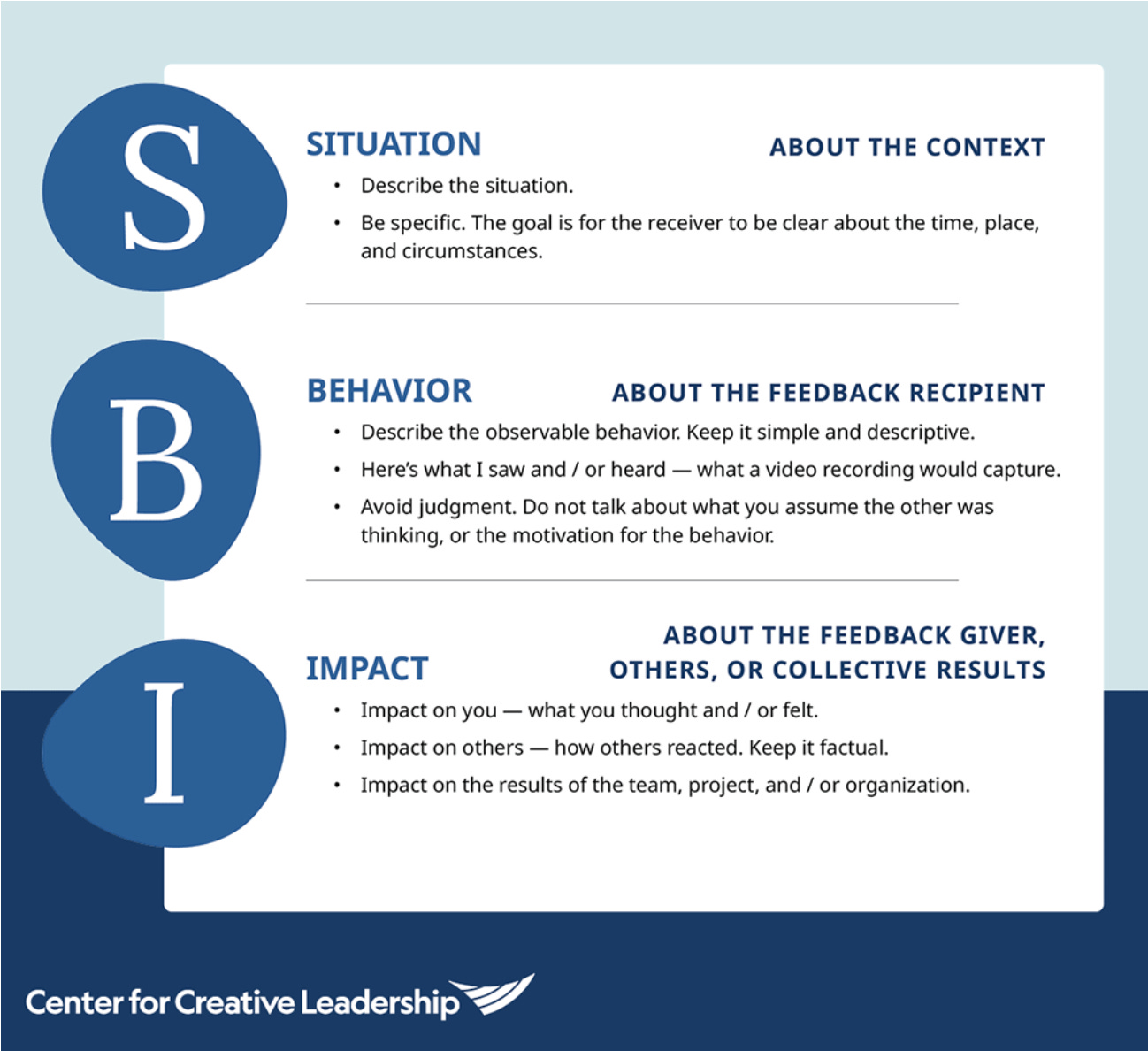
The Situation-Behaviour-Impact (SBI) framework originally developed by CCL is a concise, tried and tested tool designed to support leaders to craft and deliver feedback in a clear, objective manner. I use this all the time to create clarity, structure, and ensure relevance of conversations that matter. It focuses on three key elements:
· Situation: Describe the specific context or circumstance in which the behaviour occurred.
· Behaviour: Detail the observable actions or words of the individual, without interpretation or bias.
· Impact: Explain the effect of the behaviour on others, the team, or the organisation.
SBI allows your conversation partner to understand precisely what is being addressed, providing a launchpad for exploring together what's happening and their role (awareness), any problematic or limiting dynamics (acceptance), and both of your ideas for change (action). Remind yourself of this conversational architecture and return to it as you go, to anchor the conversation.
4. Meet people's social needs with SCARF
Remember my conversation with Greg earlier. What concerns do you think I had? Well, I was carrying a whole range of stories going about what might happen, and I certainly anticipated that Greg would react strongly to the feedback. Fight, flight, or freeze, we humans have some powerful ways to get to safety when we feel threatened.
Dr David Rock’s SCARF model identifies five domains that influence human social interactions, particularly in the workplace:
· Status: Our perception of our position relative to others.
· Certainty: Our need to predict and understand future events.
· Autonomy: Our sense of control over events.
· Relatedness: Our sense of safety with others, whether they are friends or foes.
· Fairness: Our perception of equitable exchanges between people.
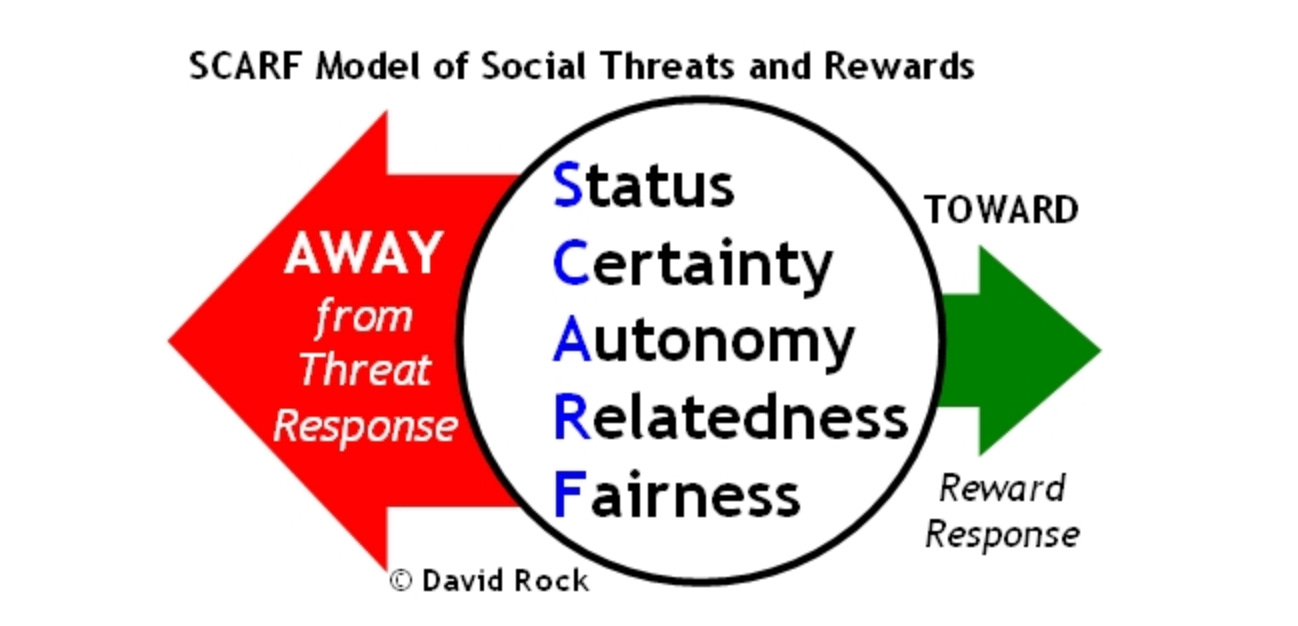
Understanding these domains helps leaders and managers navigate conversations in a way that reduces threat responses and enhances engagement and trust.
Think back to my scenario with Greg. Even if he becomes defensive, if I bring SCARF to mind, can I start to get curious what needs he's trying to have met? And can I engage more of his reward response by acknowledging one or more of the SCARF concerns, to see if he can move into a “staying with it” response versus a “fighting, fleeing or freezing” reaction? If so, quite likely, we'll be able to work together on the issue for longer.
5. In practice: How to have a conversation that matters
In your next conversation that matters, try combining Situation-Behaviour-Impact with SCARF. Here's how you can do that.
Step 1: Describe the situation
Begin by clearly identifying the situation where the behaviour occurred. Ensure the context is specific and relevant, as this helps in creating a shared understanding. Focus on enough detail to ensure that the other person can clearly bring to mind what you're talking about - and check that they have it.
Example: “During the partnership meeting with the stakeholders last Monday…”
Step 2: Describe the behaviour
Detail the behaviour observed, sticking to facts and avoiding any judgement or interpretation. This keeps the conversation objective and focused.
The key thing here is: when you have described it briefly - stop! And the reason for telling yourself to stop is that it's easy to slide into interpretations, when what you're really trying to describe is the observable action or behaviour. What would someone sitting by the side of the person have seen or witnessed?
Example: “You pitched your idea for most of the meeting, and stakeholders didn't have the same opportunity to share their thoughts. The stakeholders have approached me to ask if it's OK to book separate meetings with senior managers, to discuss their ideas."
Step 3: Explain the impact
Name and discuss the impact of the behaviour, considering how it affected others, the team or project, and the concern you have if progress doesn't come.
Example: “ As we're aiming to build capacity for collaboration and decision making within the partnership teams wherever possible, I'm concerned about the impact of people going around the process."
Step 4: Address the person’s social needs
Here, you need to get curious about how the other person is receiving what you're sending. And be prepared to ask some curious questions too, to help you understand that from their perspective - test your assumptions, live.
Useful questions here can include:
How is this conversation landing with you, so far?
What does this feedback have you thinking about?
Which parts need to be explored some more?
If you're sensing a defensive reaction, tailor your approach to manage perceived threats and foster a receptive mindset in your conversation partner. For instance, acknowledge the individual's status and contributions, offer certainty about the process, and highlight fairness in your feedback.
For example: “You have valuable ideas (status) and they're important to help us find better solutions with these stakeholders (relatedness). How might you lead (autonomy) the meeting on 20 May (clarity), to make sure everyone's ideas can be raised (fairness)? Let's check in again together after that meetup to talk about how it went (clarity).”
Bonus tip! Using SBI to gauge progress
I have found that you can also use the SBI framework to prepare for and track what happens post-conversation. Simple prompts for this stage of your work with others include:
· Situation: What situations will likely call for us to act in the new, different ways we’ve been discussing? Where and when will we see the actions we’ve discussed play out, and who will be involved?
· Behaviour: What can we expect to see happening? What behaviours and actions? How will we know that we are acting in this new and different way?
· Impact: What might the result be, when we’ve carried through the new action? What would good/early/meaningful progress look like? Could we identify signals or data points to help us understand how it’s going, as we make this change?
Wrap up
Combining the Situation-Behaviour-Impact framework with David Rock’s SCARF model provides a structured and empathetic approach to improvement conversations - the conversations that matter. By addressing specific behaviours and their impacts while considering the social domains that influence human interactions, you can foster a more constructive and positive environment for feedback and growth. Embrace this integrated approach to enhance communication, build trust, and establish a learning-friendly culture with your team and partners.
Enjoy practicing these tools and let me know how you go!
Katy
Great stuff Katy! Conversations are tough, hey? I wrote on a similar dynamic not long ago, on what might stop people from being on the same page, which I thought you might be interested in! https://open.substack.com/pub/curiositymindset/p/getting-people-on-the-same-page?utm_source=share&utm_medium=android&r=1qmpyl